General description

TRUE® Zero Waste Certification
Boost operational performance, circularity, and verifiable ESG evidence through efficient waste management.
TRUE Zero Waste drives organizations to reduce waste generation and maximize material recovery through prevention, reuse, recycling, and recovery strategies.
At THREE, we support developers, corporations, and operators throughout the certification process to integrate these strategies into asset operations and advance toward zero waste, efficiency, and sustainability goals.
TRUE ZERO WASTE
What is TRUE Zero Waste?
The TRUE Zero Waste certification, developed by GBCI, recognizes facilities that implement strategies to reduce, reuse, and recover their waste, keeping it out of landfills, incineration, and the environment. To achieve certification, projects must demonstrate a waste diversion rate of 90% or higher.
Beyond that threshold, the standard evaluates the policies, processes, and practices that prevent waste generation and sustain these results over time, from product and material redesign to purchasing decisions and day-to-day operations.
At THREE, we translate TRUE's principles into a comprehensive waste management strategy that helps reduce operating costs, strengthen ESG performance, and prepare assets for increasingly stringent environmental regulations and requirements.
Categories
The 15 Categories of the TRUE Rating System
The TRUE Zero Waste certification comprises 81 points distributed across different performance categories, providing a comprehensive assessment of how a facility prevents, reduces, reuses, and recovers its waste.
Key aspects evaluated include:
- Redesign and reduction: waste prevention at the source and process optimization.
- Reuse, recycling, and composting: recovery and reincorporation of materials and organic waste.
- Waste diversion: reduction of waste sent to landfill, incineration, or the environment.
- Zero waste purchasing: procurement criteria aimed at reducing waste and favoring reusable or recoverable materials.
- Analysis and measurement: tracking of waste streams and strategy outcomes.
- Upstream management and closed-loop systems: waste prevention and keeping resources within use cycles.
- Leadership and training: engaging people and building a zero waste culture.
- Hazardous waste prevention: strategies to avoid or reduce its generation.
- Innovation: solutions that advance beyond conventional waste management practices.
Standard update: TRUE is evolving toward a new version, TRUE v2. The information presented in this section corresponds to the TRUE system currently in effect and may be updated once the new version is officially released.
LEVELS
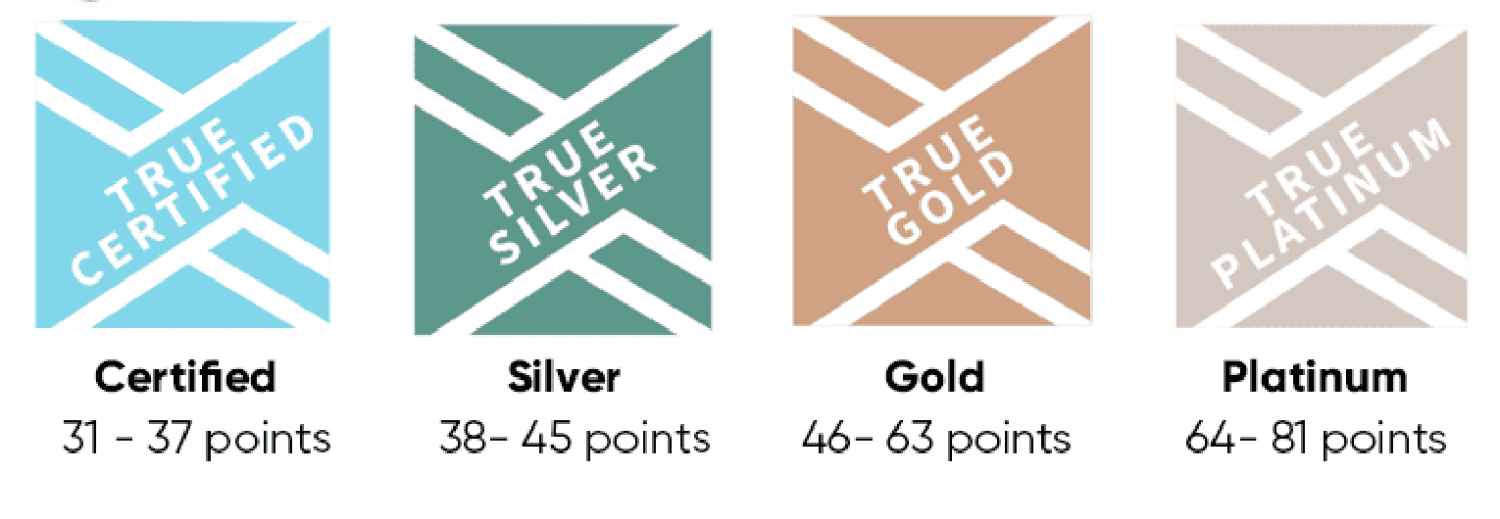
To achieve certification, a project must first meet the program's minimum requirements and earn at least 31 of the 81 available points. The total score determines the level:
REQUIREMENTS
Every project must meet these seven requirements:
- Zero waste policy
Have a current policy that establishes the project's commitment to waste prevention and reduction.
- 90% or greater waste diversion
Demonstrate an average diversion of at least 90% of solid, non-hazardous waste over the most recent 12 months, keeping it out of landfill, incineration, or the environment.
- Legal and permit compliance
Comply with the laws, regulations, and permits applicable to waste management, collection, handling, and processing.
- Maximum 10% contamination
Ensure that materials leaving the site meet the contamination limits established by TRUE.
- Annual measurement and reporting
Maintain 12 months of waste diversion data and report it to GBCI to keep the certification current.
- Case study
Document the zero waste strategies and initiatives implemented by the project and their results.
These requirements are the starting point. The certification level is determined afterward, based on the score achieved across the different TRUE categories.
Projects
TRUE applies to physical facilities and their operations. There is no minimum or maximum size, and a project may include multiple buildings or an entire campus:
- Corporate offices
- Industrial and manufacturing plants
- Distribution and logistics centers
- Schools and universities
- Hospitals and healthcare facilities
- Hotels and hospitality establishments
- Retail and shopping centers
- Stadiums and sports or event venues
- Government buildings and operations
- Nonprofit organizations
- Construction projects and major renovations
- Events, such as conferences, festivals, shows, and sporting events

BENEFITS

Certifying with TRUE not only enables better waste management. It can also generate operational, environmental, and business benefits:
- Cost savings and new revenue Reducing waste generation and optimizing its management can lower operating costs and open opportunities to recover value from materials.
- Lower carbon footprint Preventing waste and keeping materials in circulation helps reduce the environmental impacts associated with their extraction, transport, and disposal.
- Evidence for ESG reporting TRUE provides measurable indicators and outcomes that can strengthen reporting on environmental performance and resource management.
- Risk management and compliance A structured waste strategy helps identify operational risks, improve processes, and respond to increasingly stringent environmental regulations.
- Market differentiation An international certification allows a facility to demonstrate, with evidence, its commitment to resource efficiency and responsible waste management.
- Progress toward LEED Zero Waste Achieving TRUE Platinum can contribute to meeting the requirements for LEED Zero Waste, in conjunction with an applicable LEED certification for the project.
FAQS
Frequently Asked Questions
What is TRUE Zero Waste certification?
TRUE is an international standard from GBCI that measures and certifies how a facility reduces, reuses, and recovers its solid, non-hazardous waste. It certifies projects that divert 90% or more of their waste from landfill, incineration, and the environment.
What TRUE certification levels are there?
There are four levels based on the score out of a total of 81 points: Certified (31–37), Silver (38–45), Gold (46–63), and Platinum (64–81).
How many points are needed to certify?
A project must meet the 7 minimum program requirements and earn at least 31 of the 81 points in the TRUE rating system.
What is the difference between TRUE and LEED?
TRUE evaluates the waste management and resource efficiency of a facility in operation, while LEED evaluates the overall environmental performance of the building. Both are administered by the same body (GBCI) and are complementary.
Which facilities can be TRUE certified?
Offices, industrial plants, distribution centers, schools and universities, hospitals, hotels, retail, stadiums, and government facilities, as well as events and construction projects.
THREE
Turn your waste into savings and ESG evidence with TRUE
At THREE, beyond managing the certification, we support you from the waste stream audit through to certification, so that TRUE translates into lower costs, verifiable ESG evidence, and a real market advantage.
Request your TRUE assessment today.
Write to us at hello@three.com.mx